


After the U.S men’s national team beat Australia 2-0 on 19 June, Fox soccer commentator and former Swedish international Zlatan Ibrahimovic was asked live on air whether the U.S could win the World Cup. His quick answer: “Yes.”
Zlatan was not hooked up to James Cordon’s lie detector, as he was the week before, so we can’t know if he was sincere or just meeting the expectations of his U.S audience.
The question did get me wondering: What should we expect from the USMNT after their historic start to the 2026 World Cup – the first U.S World Cup group win since 2010 — and only the third in twelve World Cup appearances, after 1930 and 2010?
Six of hosts of the World Cup in the 22 tournaments before this year (or 27%) have gone on to win the tournament. Uruguay in 1930. Italy in 1934. England in 1966. West Germany in 1974. Argentina in 1978. And France in 1998.
I gathered some data to put the hype into perspective and this piece reports what I found.
Expectations are already exceeded
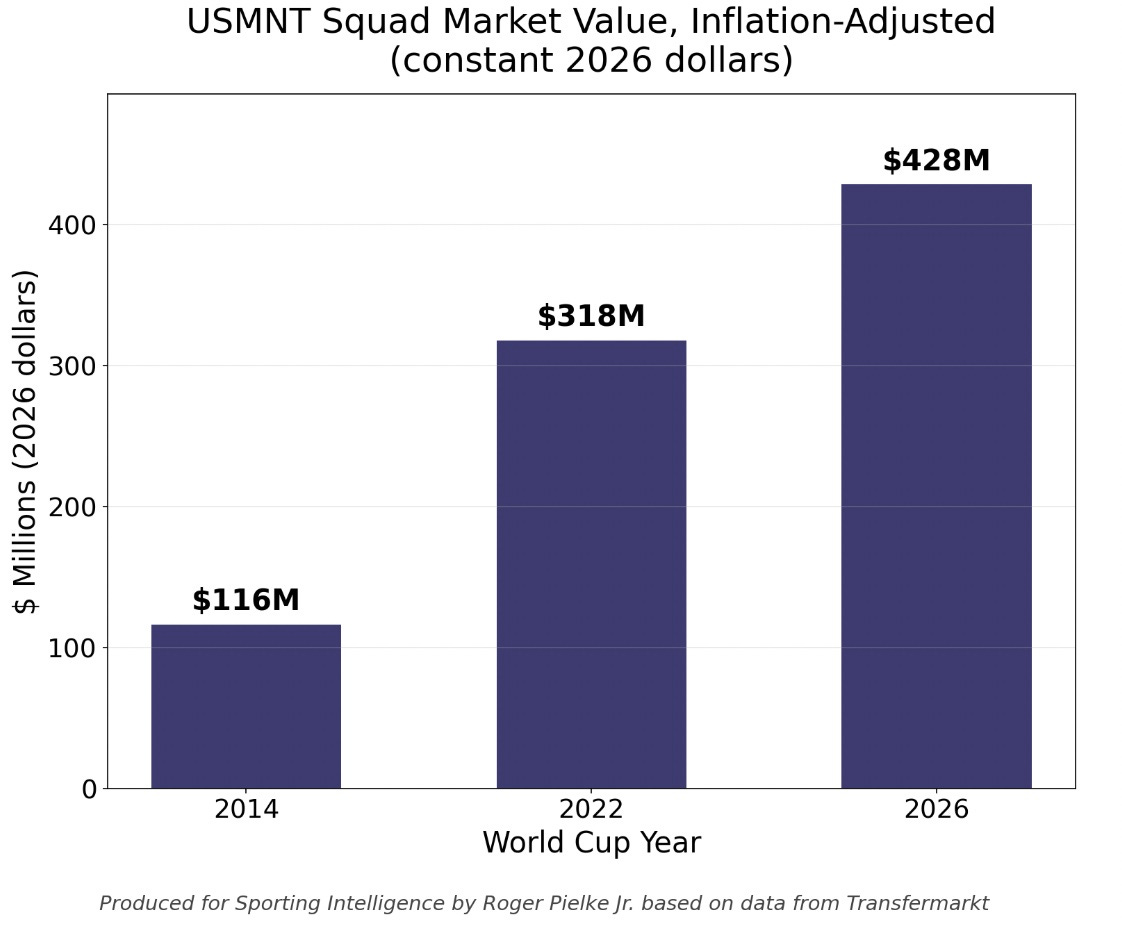
The U.S squad value, inflation-adjusted, nearly quadrupled since 2014 — from $116 million to $428 million in today’s dollars (Transfermarkt). But 16 of the nations at the tournament have higher squad valuations, from France, England and Spain on the podiium to Portugal, Germany, Brazil, Argentina, the Netherlands, Norway, Belgium and the Ivory Coast, and not all of those will top their groups, or indeed go far in the tournament.
The share of the U.S’s World Cup roster playing in Europe’s Big Five leagues climbed from nine percent in 1994 to 54 percent now, the highest ever.

The USMNT Elo rating — which scores teams based on their running performance game-by-game – tells a different story. The World Cup squad is well off the team’s 21st century nadir of 2025, but nowhere close to the ELO levels of the past two decades.
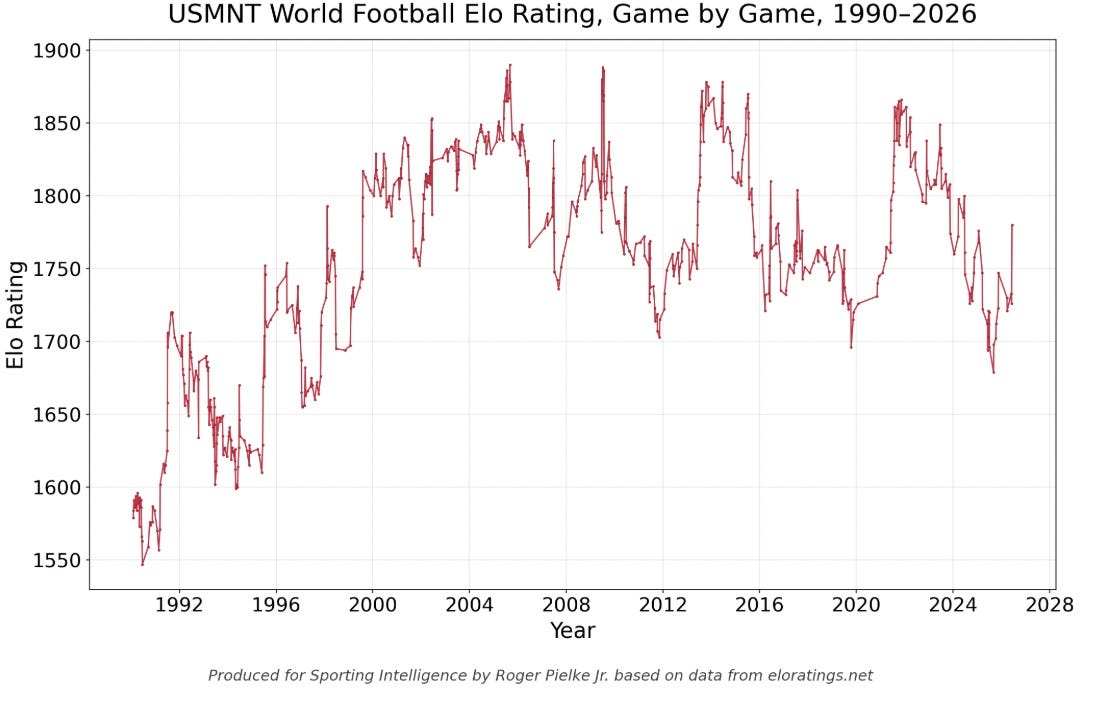
Of course, if the U.S makes a significant run in this year’s World Cup, its ELO will increase dramatically. Has manager Mauricio Pochettino unlocked potential unreflected in recent performances?
The FIFA ranking, averaged annually since 2000, makes the same point more bluntly: the U.S peaked at 9th in 2005, spent most of the 2010s stuck in the 20s and 30s, and sits at 16th now, still well off its high-water mark. But 16th beats every single annual average from 2011 through 2020.
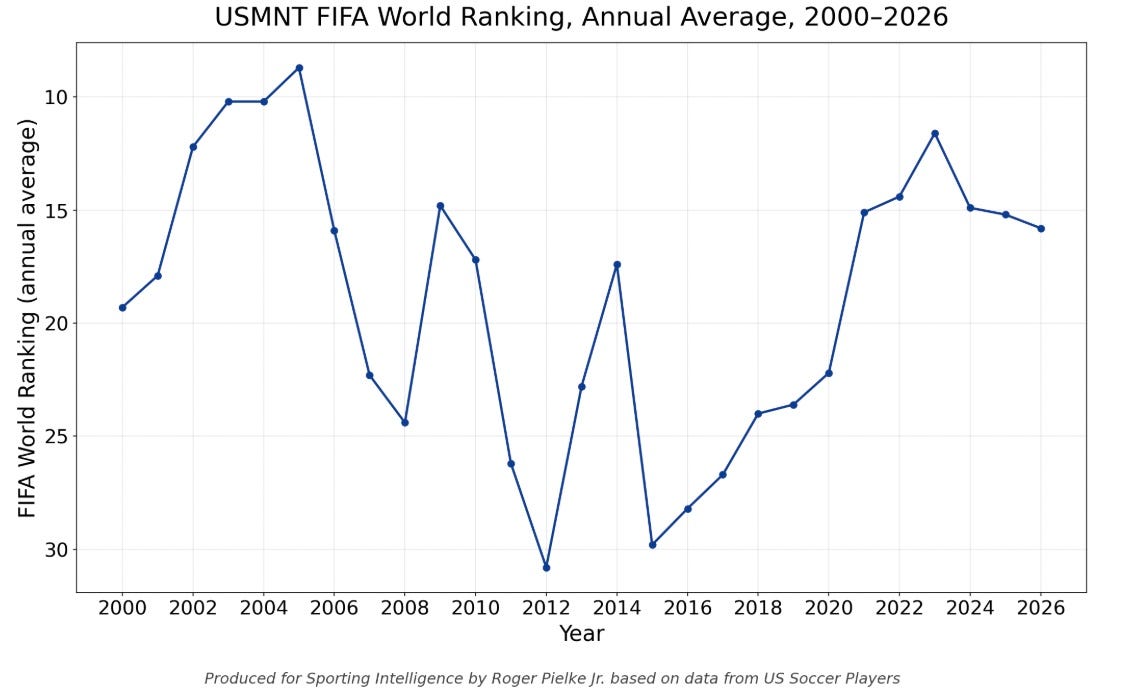
The U.S topping Group D might have been expected, given the new competition format (and more on that below) but its dominant performances does seem to outperform the numbers going into the tournament.
To put the U.S team’s performance into perspective: Its last clean sheet victory in a competitive match (not a friendly) was against Saudi Arabia, exactly one year before the Australia match.
The standard to beat dates to 2002, the last time the U.S far exceeded expectations at a World Cup: making a quarter-final run before going down to Germany. Matching that achievement will require a lot more in the coming weeks.
The U.S sits in the right neighborhood for a surprise
The cream rises to the top in the World Cup, but along the way unexpected underdogs have made notable runs. Costa Rica entered 2014 outside the world’s top 30, drew a group with Uruguay, Italy, and England, and beat two of them on the way to the quarter-finals.
South Korea in 2002, a co-host, reached a semi-final that its metrics would have never predicted. Croatia has pulled off some version of out-performance three tournaments running.
The metrics don’t always tell the whole story – also important are a mid-tier ranking where a team can outperform a stronger team on paper in any given match; hosting conditions – including a well-documented hosting home advantage; a draw that breaks right; and a goalkeeper delivering the tournament of his life.
The U.S checks all boxes: co-host, group already won, a third-place finisher waiting in the Round of 32 instead of a group winner, and its first clean sheet in exactly one year, since beating Saudi Arabia 1-0 on 19 June 2025. That’s the exact profile of team that occasionally goes further than its numbers suggest it should.
New format helped the U.S, but it stops helping soon
Forty-eight teams instead of thirty-two produces twelve groups of four instead of eight, and more groups means more uneven ones. Group D held one strong team, two credible-but-not-elite sides, and Paraguay. The U.S landed on the right side of that combination.
Eight of twelve third-place finishers now advance, versus none in the 32-team era — which foreshadows some mismatches in the first knockout round, as well as the potential for a Cinderella or two. Just imagine a match like Cape Verde vs Spain in the round of 32 that goes to penalty kicks, where anything can happen.
By the Round of 16 the 2026 World Cup, even with a Cinderella or two, competition will better resemble Cups of the past.
Past that round, the U.S plays the World Cup everyone signed up for, and even though its roster shows more than half of its players on squad in Europe’s top leagues, that same metric is overshadowed by England, France, and Spain with rosters full of players with Champions League experience that dwarfs that of U.S. players. A 2014 FA report argued that top level performance experience, like in the Champions League – is the best predictor of World Cup success.
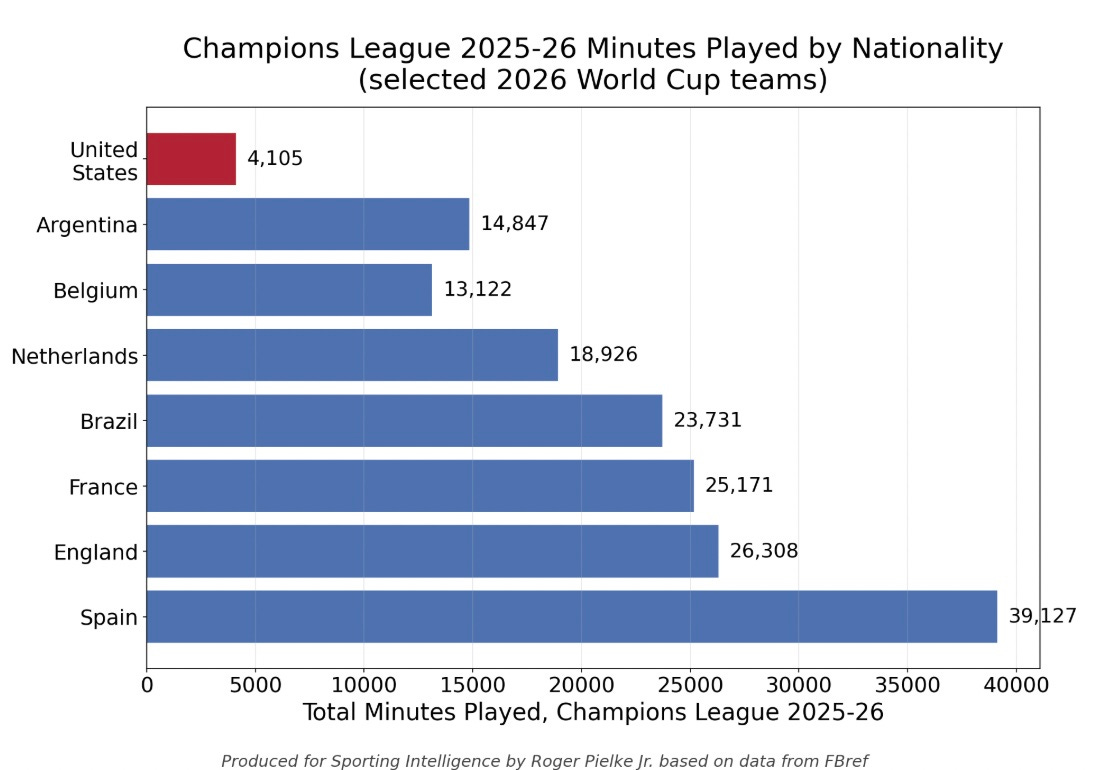
So enjoy Group D. We should expect the U.S now to make the Round of 16, as they will be favorites in their first knock-out match. Anything beyond that is a bonus for Team USA.
Roger Pielke Jr. was a professor of environmental studies at the University of Colorado, where he also directed its Center for Science and technology Policy Research. He had studied, taught and written about science, innovation, politics and sports. He has written for The New York Times, The Guardian, FiveThirtyEight, and The Wall Street Journal among many other places. He has been a regular contributor toSporting Intelligence for more than a decade See an archive of his work for SI here. Follow Roger on Twitter: @RogerPielkeJR and visit is Substack, The Honest Broker.
