

Mo Farah: a case study of asking difficult questions to a lauded sportsperson you admire
What happens when a sporting superstar who has become a cherished national figure faces issues that need scrutiny? Tact, lawyers and PRs tend to collide in the fallout

I first met Mo Farah in April 1999 when he was a shy boy, just turned 16, and he was one of 110 promising young sportspeople from the UK flown to Florida for a “mentoring” camp intended to launch them to sporting glory later in their lives.
This was a venture sponsored by British Airways and organised in association with the British Olympic Association. The Olympic medal-winning swimmer Sharron Davies was on the trip as “camp mother” and a senior mentor.
A small group of sports writers were invited along to chronicle the project, and I went as a staff writer at The Independent at the time, and wrote about it here.
Mark Lewis-Francis, then also 16, was another of the young hopefuls who would go on to become an Olympian, and indeed an Olympic gold medal winner in the 4 x 100m relay in Athens in 2004.
But of everybody at that camp, it would be Mo Farah who would go on to conquer his sport in the most emphatic fashion.
Widely considered to be one of the greatest distance runners of all time, of any nationality, he won, among many things, gold medals in the 5,000m and 10,000m at London 2012, repeating that feat at Rio 2016, and won gold medals at the athletics world championships in 2011, 2013, 2015 and 2017.
He also won half marathons and marathons, including the 2018 Chicago marathon in a European record time of 2 hours 5 minutes and 11 seconds.
There was no way that any of us, back in Spring 1999, could possibly have foreseen what a staggeringly successful career Mo would have.
In The Independent we flagged him up (below) as Mohammed Farah, a promising 16-year-old 3,000m and cross country runner , and reported what Mo told me about not being able to speak English very well when he started running at 11. He told me that it wasn’t long before that that he’d moved to the UK from Somalia with his father, leaving his mum and siblings back in Africa.
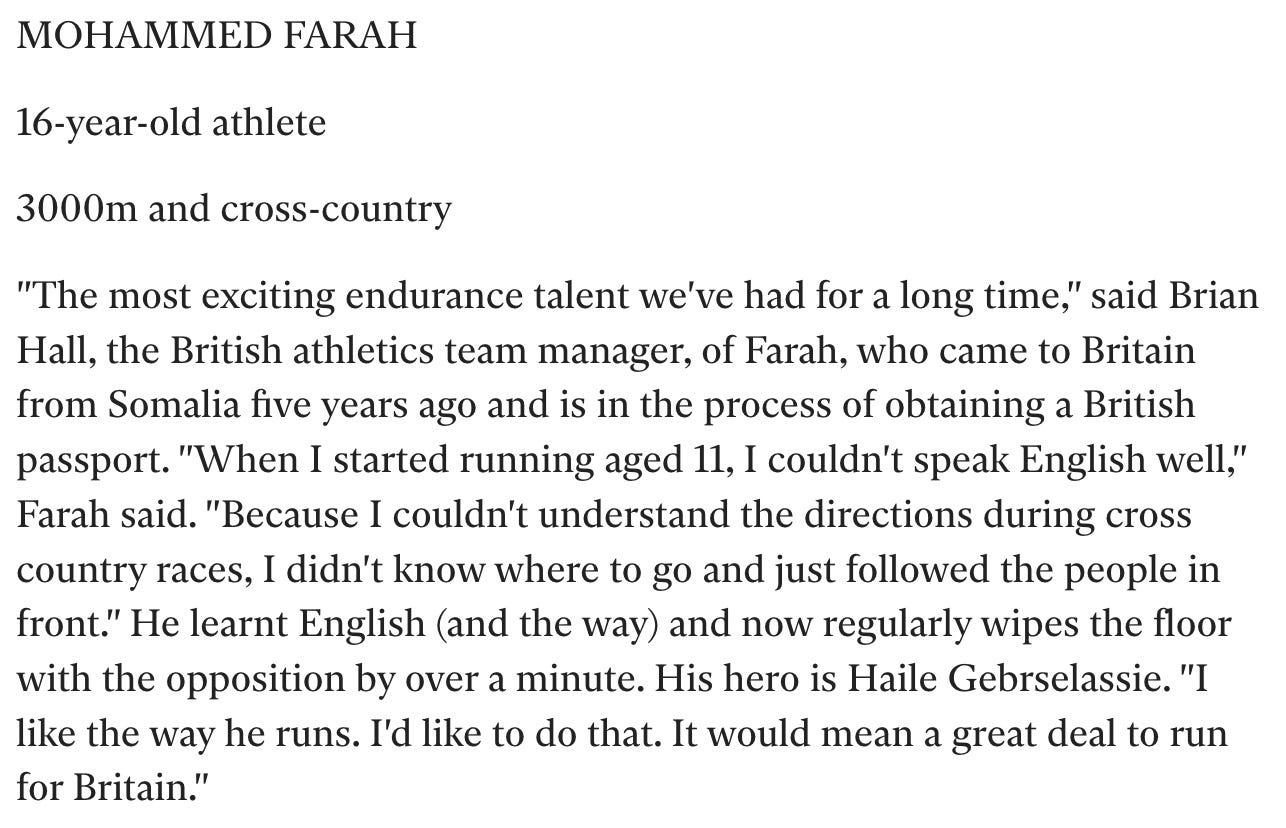
Fast-forward 13 years and Farah was one of the stars of London 2012, not least “Super Saturday”, voted as the greatest occasion for British Olympians in any Summer Games. Farah won the 10,000m gold that day, adding the 5,000m gold a week later.
“It would mean a great deal to run for Britain,” Mo had told me back in 1999, and my goodness, that certainly worked out.
As I wrote on the original Sporting Intelligence website back in August 2012: “These past two weeks, it’s meant a great deal for Britain that Mo Farah has run for it. Here is the best of contemporary Britain: a 29-year-old black, Muslim immigrant being screamed to victory by an 80,000 strong crowd as he makes the very best of all his extraordinary talent. Twice.”
Many of you reading this will know that Farah’s life and career took lots of twists and turns after 2012. Indeed in a 2022 documentary, The Real Mo Farah, he revealed he wasn’t really Mo Farah, but that he was actually born Hussein Abdi Kahin in March 1983, and that his father was killed in the Somali Rebellion when he was four, and that he was trafficked to the UK and effectively enslaved by a woman he didn’t know when he was nine.
It is an astonishing story, and the documentary was described by one reviewer as a “searing emotional confession” and “a revelation” that left viewers “punchdrunk” and “bewildered”.
To be completely frank, I was certainly bewildered. I don’t doubt for a second that Mo Farah was trafficked, or given his new identity by exploitative people, or that his entire childhood veered from traumatic to surreal.
But I’d also experienced Mo telling previous stories about his life - perhaps understandably - that didn’t turn out to be accurate. And in one case, in a matter of a couple of weeks in summer 2012, I went from thinking that Mo was a national hero and iconic role model to somebody unsure of who he really was.
The rest of today’s article, available for paying subscribers without whom this site would not exist, will explore:
How a newspaper revealed in 2012 Mo had a secret identical twin brother back in Somaliland, and Mo initially said this wasn’t true, even denying it to a journalist who was his ghostwriter (for a regular newspaper column) and friend.
How Mo’s agent, at a press conference shortly after the 2012 Olympics and the day after Mo’s wife Tania had given birth to twins, blamed me for the story about Mo’s secret twin.
How Mo’s coach, Alberto Salazar, was banned in 2019 for four years for doping offences involving athletes he coached.
How Mo, in trying to distance himself from Salazar around the same time, claimed he wasn’t sharing an apartment with Salazar earlier in his career (in 2012) when an eye witness said they were, and that there were doses of banned testosterone sitting on the kitchen counter in the apartment that Mo and Salazar were sharing. Multiple sources, including Mo’s social media and autobiography, said Mo was away from his family and sharing an apartment with Salazar at that time.
How one of Mo’s training partners in rural Kenya in 2013 and 2014 was filmed buying EPO, claiming it was for athlete associates, but after being arrested, rescinded his whole story.
