

Knicks mania left the USA's opening win as a sideshow. And in LA, politics trumped football
New York was, at best, indifferent to the opening matches of the World Cup, even the USA's stirring win in their first game. Now the NBA finals are done, will that change?

One little protest
In Los Angeles, Iran played New Zealand on Monday night in the most politicitised match in World Cup history. It also ranked as one of the more bizarre matches I’ve covered.
Near the press box, Sahand Vafadary, an Iranian American from Phoenix, remained seated when Iran scored, but instead celebrated New Zealand’s goals. He explained: “This is team is an instrument of propaganda. They killed thousands months ago. That’s a breaking point. This is my little protest.”
His stance highlighted the conflicting emotions supporters and Iranian-American household were navigating. Vafadary was among the minority in the stadium, where pre-revolutionary flags and insignia - despite a court ban - dominated but ultimately most Iranians rallied behind their team. The lion and rising sun are associated with the Shah-led regime that was overthrown in 1979 and they are seen as symbols of Iran’s anti-regime movement.
Outside the ground, a pro-Shah protest was staged, in support of Reza Pahlavi. It was vocal, but small, and odd, with pro-Trump and Israeli flags.
From a distance, Mersedeh Shahinkar watched on. She identified as pro-democracy rather than pro-Shah. An activist, her sunglasses hid that one of her eyes is blinded after she was shot by Iranian security forces in 2022 participating in the ‘Women, Life, Freedom’ protests. She won’t support the team.
“The political situation is not different from four years ago,” said Shahinkar. “The players didn’t react to the imprisoning and killing of people. This is a team of the regime. They did nothing, unlike Sardar Azmoun or Ali Karimi.”
Iran’s World Cup matches have always been politically charged. No one knows that better than Afshin Ghotbi, Iran manager’s from 2009 to 2011 and US assistant manager at the 1998 World Cup. He lives between Haarlem and Los Angeles and said: “It’s simple - every time the Iranian national team steps out and onto the pitch, there is a political angle to every pass, every tackle and every. We are at the height of it.”
The mixed zone after the final whistle provided another reminder. Iran captain Mehdi Taremi decried the organisation once again because Iran were forced to depart US soil immediately after the match, disrupting plans for a planned recovery practice the following morning in California. The road to LA had been fraught with complications - from visa refusals to a last-minute shift of the basecamp, and eventually even the journey itself.
As he left the stage, Sporting Intelligence asked the striker: “Why did the journey from Tijuana to Los Angeles (a flight typically takes 45 minuets) take five hours? A back and forth ensued.
Taremi: “It’s not too much.”
Sporting Intelligence: “Normally it takes 45 minutes.”
Taremi: “Yes, it’s 45 minutes, but what do you think about that?”
Sporting Intelligence: “I am asking you.”
Taremi: “What do you think?”
Sporting Intelligence: “I have got an idea.”
Taremi: “What’s your idea?
Sporting Intelligence: “Why did it take five hours?”
Taremi: ‘I am asking you! I want to know. Is it something you can’t say?”
Sporting Intelligence: “Was it immigration?”
Taremi: “You know it then.”
And then he was gone.
Knicks Mania
As the sun set at Battery Park last Friday, providing the Statue of Liberty with a golden glow at the most southern tip of Manhattan (below), supporters readied for the USA’s big kick-off at their home World Cup against Paraguay.
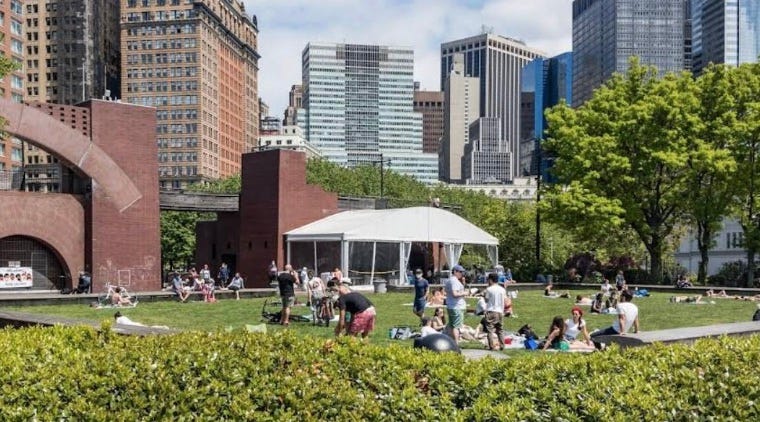
They had come adorned in the jerseys of Mexico, Dortmund, Argentina and of course the USA, but this was hardly a repeat of previous tournaments where tens of thousands of supporters fraternised at a fan zone, sharing the emotion of the World Cup.
In fact, at this tournament, New York City doesn’t have an official fan zone because of soaring costs.
And so, no more than 200 fans gathered at Battery Park.
Folarin Balogun, a striker of Nigerian descent, waltzed past the South American defence to ensure a dream start for the Americans. The match very much felt like a referendum on Mauricio Pochettino’s team and the state of ‘soccer’ in the country.
The Americans delivered with verve, with the US media describing the first half of the team’s 4-1 win as the ‘best ever’. At the end of the match, for a brief moment and in a muted manner, chants of “USA, USA” rang around Battery Park.
Emerson Orden, 19 and a football player at Florida Gulf Coast, had watched on tensely, his arms crossed. He told me: “I have seen this team come a long away after the USA didn’t qualify in 2018. The amount of fans has grown and after this performance, you can see the quality of the team. There is a correlation between performance and growing the fanbase.”
And yet, in a repeat of the 2025 Club World Cup, the poorly attended watch party reflected the Big Apple’s indifference to the beautiful game. The backdrop offered a clue. Skyscrapers were lit up in orange and blue, the colours of home favourites the New York Knicks.
The Madison Square Garden franchise were in the NBA finals and last Saturday Knicks Mania reached a crescendo when they won their first championship since 1973. New Yorkers were marking time the way football fans do when the World Cup takes place.
Around Madison Square Garden, thousands of supporters - and bandwagoning New Yorkers - partied the night away. In East Harlem, Daniel Brown, 19, from Albany, had joined a small watch party of Puerto Ricans and Africans Americans, who projected the match onto the sidewall of a brownstone.
Brown, explaining the city’s Knicks obsession, said: “A lot of people are looking for clouds, for positive news. If this had been another city, and other than the Knicks, the World Cup would get more attention.”
Brazilian boondoggle
By the time the USA notched their first win, Brazil and Morocco had played out a 1-1 draw at MetLife Stadium in New Jersey. Throughout the day, in Midtown and around Times Square, Brazilian and Moroccan shirts dominated the street view. Among those supporters walked Brazilian football officials, lots of them.
The Brazilian FA, the CBF, invited all 40 club presidents from the Serie A and Serie B to a weekend in New York City. On the sidelines of the World Cup match, they organised an immersion with MLS and the NFL to explore how American leagues commercialise their product.
It’s not unusual for teams or their sponsors to invite guests to a major tournament - the USA women’s team had more than a 100 guests at the 2023 Women’s World Cup, financed mainly by sponsors, but previous CBF president Ednaldo Rodrigues came under pressure among others for inviting too many VIPs to the 2022 World Cup in Qatar.
In an investigation, Brazilian magazine Piaui last year that detailed how CBF money covered first-class flights, five-star hotels, and match tickets in Qatar for a group of 49 VIP guests. It was one of the reasons why Rodrigues exited. Samir Xaud succeeded him and promised better to implement good governance at the organisation. Yet, it seems some habits die hard.
Box of sadness
You do wonder if the Brazilian officials were impressed at all by what they got to see in and around East Meadowlands. True to form, the MetLife Stadium - a concrete box of sadness - lived up to its reputation again. Media shuttles to the venue were in short supply, and so was water in the press box. That was after the bus driver couldn’t find the media entrance and circled the stadium for 45 minutes. After the final whistle, the elevator broke down, prompting despair from Fifa’s media officer.
There was general confusion among staff, who seemed more confused than the confused guests. “A solid 0/10,” said Karim Lahlou, a New Jerseyan with both Moroccan and Finnish roots.
The staging of the World Cup in New York and New Jersey has been highly contentious. Ticket prices - including the $33,000 front-row seats for the final - are extortionate, and fares for transit to MetLife Stadium have spiked on match days, much to the chagrin of just about everyone.
FIFA has left host cities with the burden of picking up the tab for staging matches. In response, these cities have brought on board local and international sponsors to offset costs. Texas organizers went on-brand for Houston, partnering with Aramco, Saudi Arabia’s national oil company and a FIFA global sponsor. In New York/New Jersey, the local organizing committee secured a unique sponsor of its own: law firm Paul, Weiss.
Until at least 2025, Fifa was one of Paul, Weiss’s clients. Today, Loretta Lynch - the woman who took on Fifa - works for the renowned law firm. As attorney general, she went after the world federation, prompting #FifaGate and ultimately the exit of Sepp Blatter, but Lynch has made a U-turn.
In 2020, she spoke at Fifa’s compliance conference and in 2023, she sang Fifa’s praises at the organisation’s Women’s Convention in Sydney where Lynch and her husband were attending the Women’s World Cup. At the time, Lynch failed to respond when asked if Fifa had paid her for speech and covered her travel.
Paul, Weiss did not reply to questions from Sporting Intelligence over the details and terms of the sponsorship.
This is team is an instrument of propaganda. They killed thousands months ago. That’s a breaking point. This is my little protest.”
His stance highlighted the conflicting emotions supporters and Iranian-American household were navigating. Vafadary was among the minority in the stadium, where pre-revolutionary flags and insignia - despite a court ban - dominated but ultimately most Iranians rallied behind their team. The lion and rising sun are associated with the Shah-led regime that was overthrown in 1979 and they are seen as symbols of Iran’s anti-regime movement.
Outside the ground, a pro-Shah protest was staged, in support of Reza Pahlavi. It was vocal, but small, and odd, with pro-Trump and Israeli flags.
From a distance, Mersedeh Shahinkar watched on. She identified as pro-democracy rather than pro-Shah. An activist, her sunglasses hid that one of her eyes is blinded after she was shot by Iranian security forces in 2022 participating in the ‘Women, Life, Freedom’ protests. She won’t support the team.
“The political situation is not different from four years ago,” said Shahinkar. “The players didn’t react to the imprisoning and killing of people. This is a team of the regime. They did nothing, unlike Sardar Azmoun or Ali Karimi.”
Iran’s World Cup matches have always been politically charged. No one knows that better than Afshin Ghotbi, Iran manager’s from 2009 to 2011 and US assistant manager at the 1998 World Cup. He lives between Haarlem and Los Angeles and said: “It’s simple - every time the Iranian national team steps out and onto the pitch, there is a political angle to every pass, every tackle and every. We are at the height of it.”
The mixed zone after the final whistle provided another reminder. Iran captain Mehdi Taremi decried the organisation once again because Iran were forced to depart US soil immediately after the match, disrupting plans for a planned recovery practice the following morning in California. The road to LA had been fraught with complications - from visa refusals to a last-minute shift of the basecamp, and eventually even the journey itself.
As he left the stage, Sporting Intelligence asked the striker: “Why did the journey from Tijuana to Los Angeles (a flight typically takes 45 minuets) take five hours? A back and forth ensued.
Taremi: “It’s not too much.”
Sporting Intelligence: “Normally it takes 45 minutes.”
Taremi: “Yes, it’s 45 minutes, but what do you think about that?”
Sporting Intelligence: “I am asking you.”
Taremi: “What do you think?”
Sporting Intelligence: “I have got an idea.”
Taremi: “What’s your idea?
Sporting Intelligence: “Why did it take five hours?”
Taremi: ‘I am asking you! I want to know. Is it something you can’t say?”
Sporting Intelligence: “Was it immigration?”
Taremi: “You know it then.”
And then he was gone.
Knicks Mania
As the sun set at Battery Park last Friday, providing the Statue of Liberty with a golden glow at the most southern tip of Manhattan (below), supporters readied for the USA’s big kick-off at their home World Cup against Paraguay.
They had come adorned in the jerseys of Mexico, Dortmund, Argentina and of course the USA, but this was hardly a repeat of previous tournaments where tens of thousands of supporters fraternised at a fan zone, sharing the emotion of the World Cup.
In fact, at this tournament, New York City doesn’t have an official fan zone because of soaring costs.
And so, no more than 200 fans gathered at Battery Park.
Folarin Balogun, a striker of Nigerian descent, waltzed past the South American defence to ensure a dream start for the Americans. The match very much felt like a referendum on Mauricio Pochettino’s team and the state of ‘soccer’ in the country.
The Americans delivered with verve, with the US media describing the first half of the team’s 4-1 win as the ‘best ever’. At the end of the match, for a brief moment and in a muted manner, chants of “USA, USA” rang around Battery Park.
Emerson Orden, 19 and a football player at Florida Gulf Coast, had watched on tensely, his arms crossed. He told me: “I have seen this team come a long away after the USA didn’t qualify in 2018. The amount of fans has grown and after this performance, you can see the quality of the team. There is a correlation between performance and growing the fanbase.”
And yet, in a repeat of the 2025 Club World Cup, the poorly attended watch party reflected the Big Apple’s indifference to the beautiful game. The backdrop offered a clue. Skyscrapers were lit up in orange and blue, the colours of home favourites the New York Knicks.
The Madison Square Garden franchise were in the NBA finals and last Saturday Knicks Mania reached a crescendo when they won their first championship since 1973. New Yorkers were marking time the way football fans do when the World Cup takes place.
Around Madison Square Garden, thousands of supporters - and bandwagoning New Yorkers - partied the night away. In East Harlem, Daniel Brown, 19, from Albany, had joined a small watch party of Puerto Ricans and Africans Americans, who projected the match onto the sidewall of a brownstone.
Brown, explaining the city’s Knicks obsession, said: “A lot of people are looking for clouds, for positive news. If this had been another city, and other than the Knicks, the World Cup would get more attention.”
Brazilian boondoggle
By the time the USA notched their first win, Brazil and Morocco had played out a 1-1 draw at MetLife Stadium in New Jersey. Throughout the day, in Midtown and around Times Square, Brazilian and Moroccan shirts dominated the street view. Among those supporters walked Brazilian football officials, lots of them.
The Brazilian FA, the CBF, invited all 40 club presidents from the Serie A and Serie B to a weekend in New York City. On the sidelines of the World Cup match, they organised an immersion with MLS and the NFL to explore how American leagues commercialise their product.
It’s not unusual for teams or their sponsors to invite guests to a major tournament - the USA women’s team had more than a 100 guests at the 2023 Women’s World Cup, financed mainly by sponsors, but previous CBF president Ednaldo Rodrigues came under pressure among others for inviting too many VIPs to the 2022 World Cup in Qatar.
In an investigation, Brazilian magazine Piaui last year that detailed how CBF money covered first-class flights, five-star hotels, and match tickets in Qatar for a group of 49 VIP guests. It was one of the reasons why Rodrigues exited. Samir Xaud succeeded him and promised better to implement good governance at the organisation. Yet, it seems some habits die hard.
Box of sadness
You do wonder if the Brazilian officials were impressed at all by what they got to see in and around East Meadowlands. True to form, the MetLife Stadium - a concrete box of sadness - lived up to its reputation again. Media shuttles to the venue were in short supply, and so was water in the press box. That was after the bus driver couldn’t find the media entrance and circled the stadium for 45 minutes. After the final whistle, the elevator broke down, prompting despair from Fifa’s media officer.
There was general confusion among staff, who seemed more confused than the confused guests. “A solid 0/10,” said Karim Lahlou, a New Jerseyan with both Moroccan and Finnish roots.
The staging of the World Cup in New York and New Jersey has been highly contentious. Ticket prices - including the $33,000 front-row seats for the final - are extortionate, and fares for transit to MetLife Stadium have spiked on match days, much to the chagrin of just about everyone.
FIFA has left host cities with the burden of picking up the tab for staging matches. In response, these cities have brought on board local and international sponsors to offset costs. Texas organizers went on-brand for Houston, partnering with Aramco, Saudi Arabia’s national oil company and a FIFA global sponsor. In New York/New Jersey, the local organizing committee secured a unique sponsor of its own: law firm Paul, Weiss.
Until at least 2025, Fifa was one of Paul, Weiss’s clients. Today, Loretta Lynch - the woman who took on Fifa - works for the renowned law firm. As attorney general, she went after the world federation, prompting #FifaGate and ultimately the exit of Sepp Blatter, but Lynch has made a U-turn.
In 2020, she spoke at Fifa’s compliance conference and in 2023, she sang Fifa’s praises at the organisation’s Women’s Convention in Sydney where Lynch and her husband were attending the Women’s World Cup. At the time, Lynch failed to respond when asked if Fifa had paid her for speech and covered her travel.
Paul, Weiss did not reply to questions from Sporting Intelligence over the details and terms of the sponsorship.
 | A guest post by
|